 I recently watched the movie Winter’s Tale and was pleasantly surprised by how much I liked it. The storyline centers on the romance of two star-crossed lovers, but there is a dark side to the story, as well. The movie stars Colin Farrell as Peter Lake, a mechanic/thief, and Jessica Brown Findlay as Beverly Penn, a young woman who is entering the last stages of consumption. Peter meets Beverly while attempting to rob her house, and they quickly fall in love. Unbeknownst to Peter, he has a magical gift – that of saving a life. The demonic Pearly Soames (played by Russell Crowe) acts as both the chief underworld thug of the city and the right-hand man of the Judge (who also appears to be Lucifer – an interesting role for Will Smith). Soames makes it his mission to stop Peter from enacting his miracle, something that seems to be able to have a somewhat profound effect in the scorekeeping going on between the powers of good and evil. Peter’s romance with Beverly does not quite turn out as hoped, and he somehow lives on without aging until he meets another young woman and finds out that his gift may have been meant for something greater all along.
While this movie relied mostly on story and character development, I liked the subtle use of special effects. Lighting plays a big part, and beams of light are often used – sunlight as well as starlight. The demon, Pearly Soames, shows his true face a few times, and he has an interesting tray full of jewels that he can pull light through in order to show him maps and information. Best of all, there is a guardian angel in the form of a flying white horse, whose wings are a beautiful transparent rainbow.
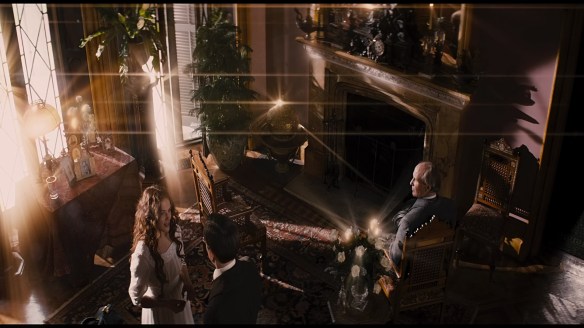
There is quite a bit of romance in the movie. If you like things like Colin Farrell riding a white horse to the rescue of a damsel in distress, then you are in luck here because that happens a few times. Overall, the movie has a wholesome, yet tragic, feel to it. There are a couple of parts played exceptionally well by children, and the love of children is another important part of the story. I think that in contrasting these elements with the darker, demonic parts of the story the movie creates an interesting balance.
The cinematography for this movie is beautiful, and the storyline is an original twist on some old ideas. Overall, I would recommend it as worth watching!


 Lorelei By Starlight