Oculus Will Mess With Your Mind

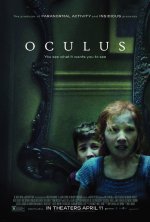
Movie poster for OculusI hadn’t really heard much about Oculus — somehow it flew under my radar when it came out — but I recently watched it and was pleasantly surprised. The movie focuses on brother and sister Tim (Brenton Thwaites) and Kaylie Russell (Karen Gillan), who survived some terrifying events when they were children. Their parents ended up dead and Tim was accused of murder and spent ten years in an institution. As the movie begins, he has just been released, convinced that he has been cured and that everything that happened to him when he was young has a perfectly logical explanation. However, Kaylie is not of the same mind, and is convinced that the problems all began with an antique mirror — one that she has managed to find. Kaylie is intent upon expunging the evil that lives within the mirror and she brings Tim along for the ride.
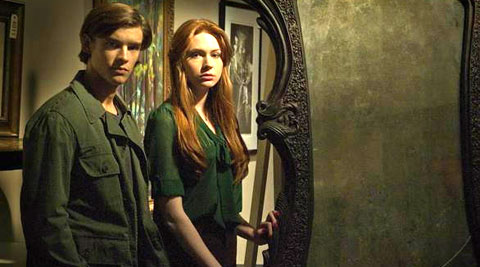
Brenton Thwaites and Karen Gillan in Oculus

Mirrors and doorways are always fascinating to me. There is a liminality — a neither here nor there — the potential for something just on the other side that is unexpected. The word “oculus” typically refers to a round opening, and the mirror in this movie is just that — an opening to something or somewhere else. There seems to be a presence that lives in the mirror, which can take hold of the minds of those close to it, the radius of power spreading as it sucks energy from those near. It changes people. It also messes with their mind. Often Kaylie or Tim is convinced that one thing is happening, when in reality something entirely different is going on. Or, they think they are in one place when in reality they are somewhere else. The mirror distorts their perception enough that it becomes difficult, if not impossible, to tell what is real and what is fantasy. Unfortunately, many of these deceptions are dangerous, and it doesn’t take long for the situation in the house to deteriorate.

Interspersed with the current attempts by the siblings to rid the mirror of its power are flashbacks to what happened years ago when they were young. Their parents are played by Rory Cochrane and Katee Sackhoff, and slowly we begin to see how the mirror corrupted their minds, caused their deaths, and destroyed the family. There are a lot of scary and disturbing situations in these parts of the film, which help lend to the seriousness of the current task that Kaylie has taken on.

This movie kept me guessing and made me jump quite a bit! If you like movies about haunted houses or possession, then you will probably enjoy Oculus.

Book vs. Movie: Under the Skin

Movie poster for Under the SkinI finally had a chance to watch Under the Skin and it’s an interesting adaptation of the book by Michel Faber (see my post on the book here). The movie was directed by Jonathan Glazer and stars Scarlett Johansson. As is typical, while there were quite a few things that I liked about the movie, there were definitely some differences from the book:

  • Isserly is way too pretty in the movie version. They would have had to do some serious makeup and changes on Scarlett Johansson in order to “dumb her down” to the level of Isserly in the book. However, the change works. Isserly’s job, after all is to be able to attract men, and who are we to question what kind of scientific talents the aliens have in body modification. This change in her appearance may also have allowed for the discarding of the “icpathua” needles in the seat of the car, since it is much more likely that her prey will be cooperative.
  • The setting of the movie is more suburb or city scenes, rather than rural highways and a farm. Glazer’s choice of using real-time interactions with people in the final film would probably have made picking up hitchhikers pretty unsustainable for filming. I think that this change actually makes the premise more believable than cruising for guys on the highway.
  • Because there is not much dialogue and no narrative, it becomes much less clear what exactly the aliens are up to. However, the abductions are still pretty creepy, even without the backstory from Faber’s book, and while the movie loses quite a bit of the original meaning it is still scary.
  • There is an added, longer interaction between Isserly and a human male, and I guess it can be argued that he takes some pains to take care of her. This situation ultimately sets the stage for the ending of the movie, but I do think the true impact of what is going on here may be a little unclear unless you have read the book.
  • The movie ends at a different point and in a quite different manner than the book. Partly, I think this is because Isserly’s motivation cannot be communicated to the viewer, so keeping with the original ending doesn’t really make sense. However, the choices made here still provide an impact, and the final scenes of Isserly’s true form are good.

NOTE: Possible spoilers follow.

So, changes aside, there were several things about the movie that I liked:

  • The music choices worked for me. Music plays a very minimal part in the movie overall, which fits with the rest of the techniques, but the use of the mainly heavy, sultry bass riffs when Isserly has secured the men in her lair, plays well with the seductiveness of her character.
  • Isserly’s creepy and completely black lair. This is an interesting aspect, not only because of the quicksand like floor that sucks down Isserly’s prey while she walks lightly on top, but also because the guys actually follow her into this decrepit building with basically no lighting! (Most of me wants to believe that this is not something that would really happen. Sigh.)

Man getting sucked down into the floor of Isserly's lair

  • The extremely disturbing beach drowning scene. This scene definitely captures the complete lack of empathy that both Isserly and her weird helpers have for the human race. Watching her reactions to the situation is bad, but watching both her and and the helpers walk past the crying toddler is worse.
  • The addition of Isserly picking up a deformed man and actively working to seduce him was extremely disturbing. It’s not quite clear, but it seems that she may have later regretted this and released him before he could be “processed”, and it looked like this could have been a turning point for her in gaining empathy with those she is hunting.

The basic themes that run through the book have to do with empathy and sexuality. In the movie, these are still present, but they have been streamlined and are communicated in ways that, due to the lack of dialogue or narrative, require a little additional thought process by the viewer. Capturing the additional ideas in the book specifically surrounding empathy for food sources, would have required much more time and a different approach. I think that what we get from the movie version is a different, but no less interesting portrayal of Isserly. Throughout most of the movie, she comes across as much more capable and calculating than Faber had portrayed her. She is a more sexualized being who is wielding that aspect of herself with a much more sure hand than Faber’s character, but then her physical appearance is also much more in line with the typical human stereotypes.

I liked the overall minimalism of the movie and the way that Glazer has managed to capture the disturbing nature of Faber’s work. If you are into the weird, you might want to give this one a viewing.