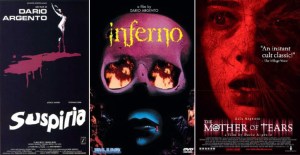
Ever since I first watched Deep Red I’ve been big fan of Dario Argento. I like the giallo genre in general. Something about the blend of elements – the overall style of the films, the mystery/slasher/supernatural, the subtle eroticism, violence, and darkness – works for me. So, over the holidays I decided to watch through the Three Mothers trilogy.
I had seen the first, Suspiria (1977), a couple times before, but watched it again to have it fresh in my mind. I had not watched Inferno (1980) or Mother of Tears (2007), so these were new to me. While there were things that I liked about all of the movies, there were a few things that stood out to me. Most of this probably has to do with the timing of when the movies were made. The first two were only three years apart, but the last didn’t come until 27 years later, which is a really large gap for a movie in a series, and the time between definitely showed.
The history of the Three Mothers story is that there were three powerful witches bent on gaining money and power. They each took up residence in a different city – Freiburg, Germany (the Mother of Sighs); New York City (the Mother of Darkness); Rome, Italy (the Mother of Tears) – and commissioned an architect to build houses for them. There are three signs associated with identifying the houses of the witches: a strange, bittersweet smell, a portrait of the mother housed underground, and a third key to be found underneath your feet.
So, here is what I saw – the first two movies are closely paired with many similarities:
- lighting – both make use of brightly colored accent lighting in reds, blues, yellows, and greens. This lends a particular feel to the darkness that infiltrates the rest of the films, and enhances the use of stained glass windows that appear throughout both films. In Suspiria stained glass serves as a dramatic way to expose the murder of one of the dancers.

- rainy cab rides – both protagonists arrive at their destinations on dark, rainy nights, after riding with some kind of weird cab drivers.
- the use of disabled characters – in Suspiria there is a blind pianist and in Inferno there is a book seller suffering from partial paralysis. Both of these characters are victimized.
- architecture – the architecture in both films creates a gothic element (while not, at least from what I remember from art history class, being technically gothic in design) and lends a brooding feeling. In Suspiria the building is a dance school while in Inferno the building is an apartment building.

- death by glass – both movies make use of this in different fashion
- killer animals – cats, rats, bats, and a dog. Both movies have groups of animals that are overtaken by demonic forces and then go on to kill. In both cases, the disabled characters are killed by possessed animals. In Inferno there is quite a bit of animal related violence – cat on rat, man on cat, cat on man, etc.
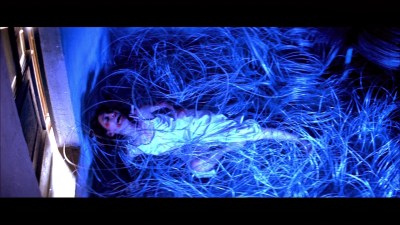
Suspiria had the advantage of having Jessica Harper (from the Rocky Horror spinoff Shock Treatment) and Joan Bennett (from Dark Shadows), along with Udo Kier (who is actually in Mother of Tears, too). The feel of this film is dark and dreamlike and there are several shocking moments and a death scene that will stay with me forever (death by room filled with snarls of razor wire).
Overall, I felt that the quality and feel of Suspiria was superior to Inferno, but I still thought that there were some interesting aspects in this movie. For example, I liked the opening of this movie where in trying to identify the odd odor surrounding her apartment building the girl explores a bit underground, and drops her keys in a sort of puddle that turns out to be an opening to an underground room that has been flooded. In this room we see evidence of the portrait of the Mother of Darkness. Additionally, I liked that there was an unpredictable nature to who the actual protagonist was – the focal point changes throughout in an interesting way.
Mother of Tears differs greatly from the others in that none of the similarities of the first two appear. (We don’t see the extreme colored backlighting, death of disabled characters by possessed animals, etc.) The plotting in this movie is more well defined, but there is also an extreme focus on violence – whereas the first two films see violence visited on individuals in secluded locations, in this film demons possess the general populace creating havoc in the city. There are also roving bands of witches that are gathering for the “rise” of the Mother of Tears. The building in this movie – rather than being actively inhabited and working as the main setting for the film – appears to have fallen into disuse, except for some homeless people sheltering in the basements. Our protagonist has the benefit of her mother’s ghost as a guide and she has some of her own, white witchcraft to call upon to help her. There are a lot of interesting “surprise!” moments – like surprise – demons!, and surprise – baby murder! The deaths in this movie are more extreme as is the sexualization. I think the most amusing part of this movie, to me anyway, was what I have deemed the “red half-shirt of power” – a relic garment that apparently bestows power upon the Mother of Tears when she puts it on.
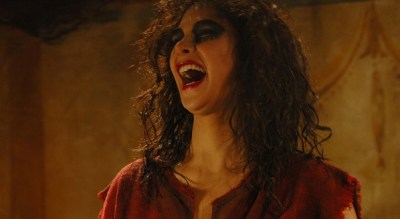
So, basically, this last movie has more plot – but also more gore, and gross-out factor. Oh, and only one, solitary possessed monkey.
Overall, I wish, that the third had stuck more closely to the format of the first two – to me, they were more along the lines of traditional giallo, whereas the last branched out more into horror. I did, however, enjoy watching these three movies so close together.

 I recently had the good fortune to read the most recent book by
 Lorelei By Starlight