Of course, Halloween is my favorite time of the year, so I’m already starting to get geared up for a month of horror! Recently I decided to revisit the Halloween franchise à la Zombie, and here’s some thoughts about both of these movies.
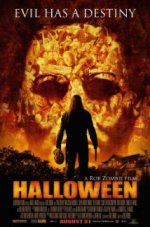 Halloween
I really like the way that the setting is crafted in this movie. The music is something that I especially cued in on the first time I watched this, and I appreciate how the choices fit with everything else. (Nazareth’s “Love Hurts” is used especially effectively.) Carpenter’s version is pretty tame, but Zombie sets up Michael’s psychological issues as based in a problematic home. Seeing Michael Myers as a neglected child does something different. I don’t necessarily feel sympathy for him, and it doesn’t seem to make him less of a monster, but it clarifies the character somehow. In some ways, I think it actually makes hims more frightening, since we have this back story of his decline into his own inner world of fantasy. When Michael finally snaps, we saw it coming. I mean, we knew it was coming because we’ve seen this story before, but this time we saw the things that the parents and others involved were oblivious to. We saw Michael Myers being created.
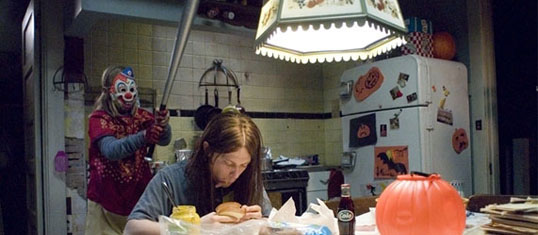 Michael is further forged by years in an insane asylum. I found it interesting to note how completely alone Michael seems at this point. There are, for the most part, no other patients apparent in this asylum — only his egomaniac psychiatrist and the people working there. These scenes of mostly empty rooms and areas just emphasize the isolation of this crazy little kid.
I think that one of the most disturbing scenes in this movie is our first look at Michael’s cell after being incarcerated for 15 years. The walls are completely covered with different masks, and he appears to continually work on creating these. An earlier scene has his mother telling him to take off his mask and he states that he needs it to cover his “ugly face.” This, as demonstrated in his original killing spree, is the face of the part of him that is so enraged and disturbed; the one that kills. His fascination with masks appears to be his way of escaping from himself, and finally he escapes completely into his own world of hatred and violence.
One thing that interested me in this movie is that once Michael has found Laurie and makes contact with her, there is a pause for a few short moments, where Zombie lets us ponder the question of what would have happened if she had accepted him. Of course, she can’t — he’s a crazed freak in a mask — but the idea is implied in their interaction, and it is also clarified that her rejection of him (in the form of attempting to kill him) is not one that she can take back. It seems like it’s at this moment that the switch inside Michael’s head completely flips and he becomes focused on killing her. But here, Zombie also provides us with some ideas as to why Michael is so focused on killing Laurie. He wants to bring his family, at least the members that he felt close to, back together.
 Halloween II
I liked that there were similarities with this movie and Carpenter’s second. It also continues immediately from where the first left off. The ambulance delivering Michael’s body to the morgue hits a cow, and he escapes. It seemed like this second movie was more brutal and crazed than the first, and this first accident is an example of how Zombie doesn’t shy away from realistic brutality. The first thing I thought was, oh yeah, air bags weren’t so much a thing back then. This handling of physical injury is also reflected in the operating room scenes — glass and gaping skin — not pretty, but also likely close to what the end result of Michael’s level of violence would be, I’m guessing.
We also don’t see Laurie as someone who has somehow managed to adapt after such a traumatic experience. She is pretty much hanging on by a thread and the drugs that she can get from her shrink. I am thinking this end result is much more likely after being chased around and almost killed by a maniac. I also like the setting changes here. The girls’ rooms, the clothes Lauri wears, her car, and the music all move this part of the story forward providing a separation from the previous installment.
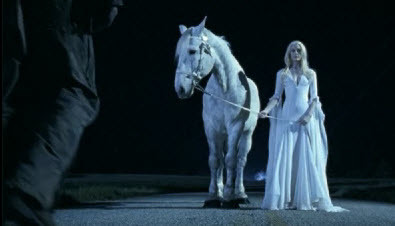
In this film, there is also a lot more done with visions and dissociative aspects for both Michael and Laurie, who are both seeing their mother and a white horse, which symbolizes “purity and the drive of the body to release powerful and emotional forces, like rage with ensuing chaos and destruction.” It becomes a lot more clear that Michael is split between his monster self and the young boy he used to be, and Laurie is fighting against a psychic pull from him and his desire to reunite their family in what would appear to be a bloody death.
The killings in this movie are brutal and I found it interesting to note that most of them are head focused: sawing off, stomping, stabbing, bashing — there is lots of head brutality. This seemed to be connected to Michael’s own hatred of his face, his covering of his “ugly” face with a mask.
One of the things that I found interesting about both this movie and the first one is how frequently we actually see Michael’s face. In the original movies he was a faceless monster, always behind the mask. In these movies, the mask is removed several times — but the point is that it doesn’t matter. Seeing him as a human, seeing his face, does not reduce the fear. When looking into a human face, we would like to believe that there is an advantage, some kind of empathy for a like being. However, with Michael there is just emptiness, a shell of humanity covering something much darker.
I like that there is the possibility in this movie of a more definitive ending. I also like that Laurie doesn’t come out of this just fine and dandy, moving on with her life. The darker and more probable ending that Zombie presents in the film provides a haunting closure to the story. I will additionally say that the covered version of Nazareth’s “Love Hurts” here adds an unbelievable amount of depth and a broken creepiness to the scene, and it provides a nice connection with the first film. I know that Zombie got a lot of flack for this movie, but my opinion is that this is really, really good, dark horror.
So, while I will always love the original Halloween franchise, I feel that Zombie’s take is a valid and darker re-imagining of this character. Feel free to chime in with your take on the two versions in the comments!

 When I first read Brian McGreevy’s book,

 Lorelei By Starlight