American Elsewhere: Flirting with the Weird

Cover of American ElsewhereI read several reviews for Robert Jackson Bennett’s American Elsewhere and became increasingly intrigued because none of them could seem to explain what exactly this book was about. After reading it, I see the problem — it really doesn’t quite fit into any particular mold, something that Bennett has mentioned himself in a few interviews. That being said, the book is one that sucked me in immediately and which I had a hard time putting down.

The first chapter pulls you into a kidnapping in progress. A man is forcibly taken from his home, driven out to the woods, and then left there — with a small rabbit skull on his chest. The skull then proceeds to kill(?) him. From there, the book just gets weirder.

The protagonist of the story is Mona Bright, whose father has just died. She has been mostly estranged from him since the suicide of her mother, but comes back to see to his final arrangements. He has left her an awesome car (which she was expecting) and a deed to a house her mother owned (which she had no idea about) in a strange town called Wink. The town of Wink is a mixture of Los Alamos and Stepford — a former haunt of brainy scientists gone all Pleasantville after the lab shut down. As soon as Mona gets there, she realizes that something isn’t right. From her odd encounter with the motel manager, to the even weirder lady in the town records office, she becomes more and more entangled in the town and the mysterious history of the mother that she never really knew.

The reason that the reviews I read of this book didn’t tell much about it is because you just can’t without giving away the fun of the surprises that Bennett has in store around every corner. Just when you think you know what’s going on, you are reminded that you really have no idea what is going on. The story weaves mystery and oddball characters with atmosphere in a manner that is reminiscent of Twin Peaks, and the underlying secrets that Mona uncovers are something different altogether. Bennett can go from a feeling of almost normality to one of eerie darkness in a flash. Some characters are just too dark and weird to even comprehend. For example:

“There is a man standing in the exact center of the garage. He is very tall, and he stands motionless with his arms stiff at his sides. He wears a filthy blue canvas suit, streaked with mud in a thousand places, and sewn onto the surface of this suit are dozens and dozens of tiny wooden rabbit heads, all with huge staring eyes and long, tapered ears. On his face he wears a wooden helmet – or perhaps it is a tribal mask – whose crude, chiseled features suggest the blank, terrified face of a rabbit, complete with curving, badly carved ears. Where its eyes should be are two long rectangular holes. Somewhere behind these, presumably, are the eyes of the mask’s wearer, yet only darkness can be seen.”

Why rabbit heads, Bennett? (I kept thinking of Anya on Buffy who was scared of rabbits.) The answer is actually in there for the reader, and I appreciated that Bennett didn’t spoon-feed it to us, but rather let us puzzle it out on our own. This book is a smart and interesting synthesis of a variety of genres, and it was a fun read. I’m definitely looking forward to checking out some more of Bennett’s work!

Book vs. TV: Hemlock Grove

He had not actually known what to expect in coming here tonight, much less that it would reveal to him two essential truths of life: that men do become wolves and that if you have the privilege to be witness to such a transformation
it is the most natural and right thing you have ever seen.

Original cover of Hemlock GroveWhen I first read Brian McGreevy’s book, Hemlock Grove,  a couple years ago, I fell in love with it. It was one of those nice surprises that I sometimes find on the library shelves — completely unheard of up to that point, a complete unknown. Recently I re-read the book for a book club, and I have also watched the two seasons of the TV series on Netflix. This particular work is interesting to me in that the TV series (the first season, anyway) actually seems to be a very nice complement to the book. Reading the book again I often found myself thinking, oh, I guess that was in the series and not in the book. But, I’m getting ahead of myself. First, the book.

At it’s heart, the book is a murder mystery — a serial killer murder mystery. Someone is killing young girls in Hemlock Grove and tearing them up, limb from limb, much as a wild animal might. Teenagers Peter (a gypsy werewolf) and Roman (an upir, a kind of vampire) team up to find and stop the killer, as well as prove Peter’s innocence of the crimes. Other characters in the book are Roman’s sister, Shelley, who is a Frankenstenien creation; Roman’s mother, Olivia, a seemingly ancient and ageless upir; Roman’s cousin, Letha, who is experiencing a “virgin” pregnancy; Peter’s cousin, Desi, who is a cross between a seer and a voodooist; and a variety of other interesting characters that round out the quirkiness of the town. What makes the book special is not only the fun that McGreevy has had playing with various horror tropes, but also the relationship between Roman and Peter, whose dialogue is often just very clever, realistic, and cool at the same time.

McGreevy’s prose is hard to describe. A few paragraphs will go by and you will think that you have it — matter-of-fact descriptions befitting the teenage protagonists of the work.

“The only reason we started burying the dead in the first place was to keep predators from getting a taste for human flesh,” said Roman.
“Is there like a summer camp for serial killers?” said Peter.
Roman shut up. They dug.

But then, bam! He will throw out some gorgeous lines that stick in your head like poetry

“Today I have seen the Dragon …” said the man.
She held out her hand.
“Don’t –” said Roman.
But the man took her hand and held it, a flower known to be extinct.

or

The fact was he could provide no rational explanation for why he was here. Last night his crying wife had left the room and he had remained seated and his child had taken his hand across the table with the grace of the sunrise, and in that moment when there wasn’t another comprehensible thing left to him he had a feeling.

or he’ll throw in some heartbreaking realism from the point of view of an older character

Their first time had been on this floor many years ago. If it had seemed like he couldn’t have felt worse about it then it was because he had been too young a man to know yet that time is cyclical, that there is no upward limit to the number of times you can make the same mistake.

The book is crafted well, and it kept me guessing almost to the end. The reveal and capture of the killer is handled in an interesting fashion, and because of the character development throughout there is still room afterwards for a few more reveals.

Roman and Peter in Hemlock Grove

So, it is clear that I loved the book. And, I was actually pretty excited to see what Netflix would do with it. The series was well cast with Landon Liboiron as Peter, Bill Skarsgård as Roman, and Famke Janssen as Olivia. The first season follows the book to the end, and does a pretty good job of sticking with the story. I liked several things especially well:

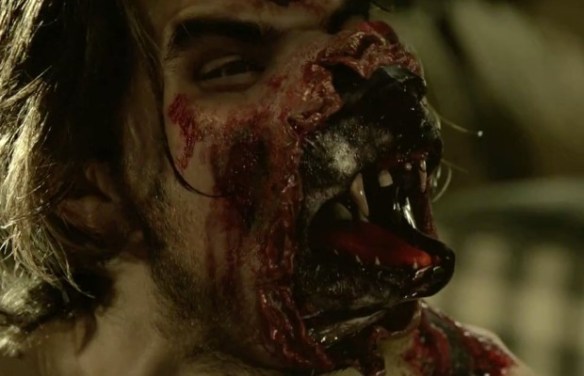
  • the werewolf transformation — good special effects along with an interesting take on all of the intricacies of disposing of human skin, etc.

Peter's transformation into a werewolf

  • the changes made to Shelley’s character — these had the effect of making her more believable, sympathetic, and creepy all at the same time.
  • the changes made to the plot surrounding the Godfrey Institute and Ouroboros
  • the way that Roman and Peter’s friendship was handled — lots of comedy along with the scary, which I think is actually pretty hard to pull off

As mentioned before, I have found that the book and the first season work well when you have experienced both. The TV series works to flesh out some of the ideas in McGreevy’s book that were only hinted at, or which were given a more minimalist treatment. But, without McGreevy’s book, you miss out on much of the character development, back stories, and that beautiful prose. I recommend both iterations of the story for the best experience.

The second season of the series became available on Netflix in July. It picks up from where the first left off with some new characters and a continuation of one of the plot lines from the previous season. While I felt the first season was better, there were some good things about the second season, as well, and it definitely ends in an interesting enough manner to make me curious what they will do next.