He had not actually known what to expect in coming here tonight, much less that it would reveal to him two essential truths of life: that men do become wolves and that if you have the privilege to be witness to such a transformation
it is the most natural and right thing you have ever seen.
 When I first read Brian McGreevy’s book, Hemlock Grove, a couple years ago, I fell in love with it. It was one of those nice surprises that I sometimes find on the library shelves — completely unheard of up to that point, a complete unknown. Recently I re-read the book for a book club, and I have also watched the two seasons of the TV series on Netflix. This particular work is interesting to me in that the TV series (the first season, anyway) actually seems to be a very nice complement to the book. Reading the book again I often found myself thinking, oh, I guess that was in the series and not in the book. But, I’m getting ahead of myself. First, the book.
At it’s heart, the book is a murder mystery — a serial killer murder mystery. Someone is killing young girls in Hemlock Grove and tearing them up, limb from limb, much as a wild animal might. Teenagers Peter (a gypsy werewolf) and Roman (an upir, a kind of vampire) team up to find and stop the killer, as well as prove Peter’s innocence of the crimes. Other characters in the book are Roman’s sister, Shelley, who is a Frankenstenien creation; Roman’s mother, Olivia, a seemingly ancient and ageless upir; Roman’s cousin, Letha, who is experiencing a “virgin” pregnancy; Peter’s cousin, Desi, who is a cross between a seer and a voodooist; and a variety of other interesting characters that round out the quirkiness of the town. What makes the book special is not only the fun that McGreevy has had playing with various horror tropes, but also the relationship between Roman and Peter, whose dialogue is often just very clever, realistic, and cool at the same time.
McGreevy’s prose is hard to describe. A few paragraphs will go by and you will think that you have it — matter-of-fact descriptions befitting the teenage protagonists of the work.
“The only reason we started burying the dead in the first place was to keep predators from getting a taste for human flesh,” said Roman.
“Is there like a summer camp for serial killers?” said Peter.
Roman shut up. They dug.
But then, bam! He will throw out some gorgeous lines that stick in your head like poetry
“Today I have seen the Dragon …” said the man.
She held out her hand.
“Don’t –” said Roman.
But the man took her hand and held it, a flower known to be extinct.
or
The fact was he could provide no rational explanation for why he was here. Last night his crying wife had left the room and he had remained seated and his child had taken his hand across the table with the grace of the sunrise, and in that moment when there wasn’t another comprehensible thing left to him he had a feeling.
or he’ll throw in some heartbreaking realism from the point of view of an older character
Their first time had been on this floor many years ago. If it had seemed like he couldn’t have felt worse about it then it was because he had been too young a man to know yet that time is cyclical, that there is no upward limit to the number of times you can make the same mistake.
The book is crafted well, and it kept me guessing almost to the end. The reveal and capture of the killer is handled in an interesting fashion, and because of the character development throughout there is still room afterwards for a few more reveals.

So, it is clear that I loved the book. And, I was actually pretty excited to see what Netflix would do with it. The series was well cast with Landon Liboiron as Peter, Bill Skarsgård as Roman, and Famke Janssen as Olivia. The first season follows the book to the end, and does a pretty good job of sticking with the story. I liked several things especially well:
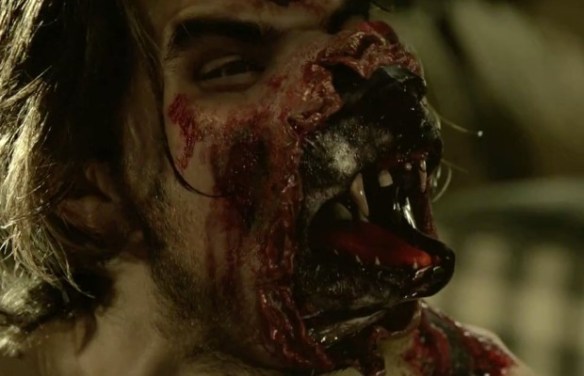
- the werewolf transformation — good special effects along with an interesting take on all of the intricacies of disposing of human skin, etc.
- the changes made to Shelley’s character — these had the effect of making her more believable, sympathetic, and creepy all at the same time.
- the changes made to the plot surrounding the Godfrey Institute and Ouroboros
- the way that Roman and Peter’s friendship was handled — lots of comedy along with the scary, which I think is actually pretty hard to pull off
As mentioned before, I have found that the book and the first season work well when you have experienced both. The TV series works to flesh out some of the ideas in McGreevy’s book that were only hinted at, or which were given a more minimalist treatment. But, without McGreevy’s book, you miss out on much of the character development, back stories, and that beautiful prose. I recommend both iterations of the story for the best experience.
The second season of the series became available on Netflix in July. It picks up from where the first left off with some new characters and a continuation of one of the plot lines from the previous season. While I felt the first season was better, there were some good things about the second season, as well, and it definitely ends in an interesting enough manner to make me curious what they will do next.


 Lorelei By Starlight