Joe Hill’s NOS4A2: A Blend of Dark Fantasy and Horror

Cover of NOS4A2I was completely blown away by Joe Hill’s book, NOS4A2. I have read some of his previous work – Horns and Heart-Shaped Box – but with his most recent book, Hill has definitely crafted a treasure. It’s all here in this book. It is tight and it is just a lovely little package of dark fantasy and horror wrapped up and waiting for you. You must go read this now.

The gist of the story is that Victoria (Vic) McQueen learns as a young girl that she can travel to wherever she needs to go via a bridge – the Shorter Way Bridge – that just kind of appears for her. The bridge is magical and conjured into reality by Vic when she concentrates on an object or place, and initially she can only conjure the bridge when she is on her Raleigh. She begins by using the bridge to help her find things that she is looking for – a lost bracelet, a misplaced picture, etc. One day, though, Vic goes out looking for trouble and finds it in Charlie Manx, who steals children and travels his own version of magic roads to a place he calls Christmasland. Vic escapes Manx when she is a child, but later, as an adult, she must find and confront him again in order to rescue her own child.

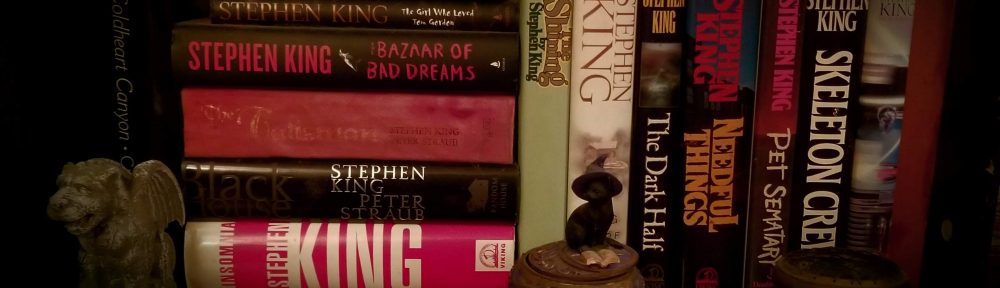
I liked that this book follows Vic from childhood to adulthood. I also like the character Hill has created – she is a real woman, and not a stereotype. I know several women like her and everything about her personality, skills, and history rings true. She has tattoos and knows how to use both a wrench and a pen. What I think I especially like about the book is how skillful Hill is at writing this woman. This is clearly written by a man who finds strong, eccentric women attractive and is not threatened by them. I found myself thinking about this a lot as I read. I am well aware that Joe Hill is the son of Stephen King, and while Hill has most definitely made his own name as a writer, I did find myself thinking about some of Stephen King’s work – especially Lisey’s Story, a book in which I felt King did a superior job of writing a real woman. Both of these men get it.

But, Hill definitely has his own style. I can feel my generation in his words. It’s something underlying the descriptions,

Vic squeezed the brake, let the Raleigh gently roll to a stop. It was even more dilapidated than she remembered, the whole structure canting to the right so it looked as if a strong wind could topple it into the Merrimack. The lopsided entrance was framed in tangles of ivy. She smelled bats. At the far end, she saw a faint smudge of light … The bridge waited for her to ride out across it. When she did, she knew that she would drop into nothing. She would forever be remembered as the stoned chick who rode her bike right off a cliff and broke her neck. The prospect didn’t frighten her. It would be the next-best thing to being kidnapped by some awful old man (the Wraith) and never heard from again.

the choice of characters,

Lou worked out of a garage he had opened with some cash given to him by his parents, and they lived in the trailer in back, two miles outside of Gunbarrel, a thousand miles from anything. Vic didn’t have a car and probably spent a hundred and sixty hours a week at home. The house smelled of piss-soaked diapers and engine parts, and the sink was always full. In retrospect Vic was only surprised she didn’t go crazy sooner. She was surprised that more young mothers didn’t lose it. When your tits had become canteens and the soundtrack of your life was hysterical tears and mad laughter, how could anyone expect you to remain sane?

the towns and locations. There is a rougher feeling that is smoothed out by the Christmas theme of the book and the magic that infuses the story, from the Shorter Way Bridge to Manx’s malicious car. While it feels much like something King would write, it’s not. It’s all Hill. And it’s all wonderful. I want to carry this book around with me and read it again. I love that there isn’t a neatly wrapped ending, and that the comments he provides in “A Note on the Type” are even less neat than the “official” ending. I think I’m a little in love with Joe Hill at this point, so it’s possible that I can’t really talk about this book coherently. Man. Joe Hill. I can’t wait for the next one!

Michel Faber’s Under the Skin

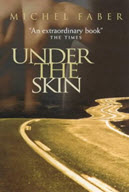
Cover of Under the SkinThis weekend I finished Under the Skin by Michel Faber, and it was another one of those books that I just couldn’t put down! Neither the book nor the movie was anywhere on my radar until recently. So, while waiting for the DVD to release I decided to read Faber’s book.

POSSIBLE SPOILER ALERT: While I think the premise of the movie has been pretty well advertised by now, it is possible that talking about the book might ruin it for those that haven’t read or watched yet.

The protagonist, Isserly, is slowly revealed to be something other than the well endowed human she appears to be. She cruises the A9 in Scotland over and over each day picking up hitchhikers, evaluating them to determine whether they will meet her needs, and then either discarding them safely at their destinations or anesthetizing them and taking them back to the farm where she resides. If the unlucky men – for her victims are always men – are taken to the farm, some very nasty things happen to them. From the start I was hooked by Faber’s writing style. He has a beautiful literary prose that creates an interesting contrast with the dark activities that are the heart of this story, and his writing is especially beautiful when Isserly is admiring nature.

Most distracting of all, though, was not the threat of danger but the allure of beauty. A luminous moat of rainwater, a swarm of gulls following a seeder around a loamy field, a glimpse of rain two or three mountains away, even a lone oystercatcher flying overhead: any of these could make Isserly half forget what she was on the road for. She would be driving along as the sun rose fully, watching distant farmhouses turn golden, when something much nearer to her, drably shaded, would metamorphose suddenly from a tree-branch or a tangle of debris into a fleshy biped with its arm extended.

It quickly becomes clear that Isserly is uncomfortable driving. She drives slowly, cautiously, but is often frightened. Road signs cause her anxiety, and the thick glasses that she wears make it hard for her to see. She is too short to fit comfortably in the seat, and due to the body modifications that she has endured, she is in almost constant pain.

These modifications, though, were absolutely necessary, because Isserly is from an alien race who has come to Earth to harvest humans. This reveal, while it seems big, comes very early in the book, and Faber does an interesting job leading up to this by inserting alien terms (such as “icpathua,” the name of the alien anesthetic that she uses) into what often appear to be a normal passages.  However, it soon becomes clear that the real heart of this story is not what the aliens are doing, but the ideas that surround it. Amlis Vess, son of the owner of Vess Enterprises on Isserly’s home planet – Vess Enterprises being a marketer of meat, mind you – comes to visit the operation. Vess is opposed to the introduction of meat into the planet’s food system. Isserly is attracted to him even as she tries to convince herself that she finds him distasteful. Vess represents all that she is not: higher class, beautiful, and privileged. Isserly was forced into this job because otherwise she would have been relegated to what amounted to work camps, her own beauty was stripped away from her as her last chance at survival, and all of this due to her low status in society.

Through the interactions of Vess and Isserly, Faber presents a variety of different dilemmas for consideration, the overarching theme of which is centered on Vess’s question: Aren’t we all the same under the skin? Their conversations and beliefs about what it means to be “human” are further complicated because Isserly’s race refers to themselves as “human beings” while referring to us as “vodsels”. This inversion, along with the overall idea of evaluation and culling for prime vodsels – the mainstay of Isserly’s job – brings up the idea of all of the ways that there are to determine either inclusion or exclusion. For instance, Isserly is careful to keep the fact that the vodsels are able to communicate from Vess, which implies that this could be a deal-breaker for many on her planet, and an act that further blurs the possibility of being able to see the two species as similar. When a captured vodsel spells out the word “mercy” in front of Vess, he asks her what it means.

Isserly considered the message, which was MERCY. It was a word she’d rarely encountered in her reading, and never on television. For an instant she racked her brains for a translation, then realized that, by sheer chance, the word was untranslatable into her own tongue; it was a concept that just didn’t exist.

Isserly’s own near brush with violence forces her into a position where she needs mercy, but unfortunately she is unable to even pronounce the word correctly, having never heard it said in all the years that she has been on Earth. And so the creatures from a merciless planet are unable, unwilling, to show mercy to us here on Earth, which it seems may be a fairly merciless place itself.

The anger and lack of empathy that Isserly displays throughout the book are constantly at odds with the appreciation she has for the beauty of nature and animals. This taken in conjunction with her refusal to empathize with vodsels, or allow them to have any essence of “humanity,” makes her monstrous. However, like many monsters we know, she has a past that has made her this way. We can often understand her reasoning, but it is always lacking what we would call a “humanizing” element. There is an almost narcissistic entrenchment in her own pain and anger, and while we can sympathize with her, we cannot empathize, because that is the emotion that she is missing.

I thoroughly enjoyed this book and have a feeling that it is one that I will be re-reading over the years. The movie should be available on DVD soon, and while I am sure that it cannot capture quite the same ideas as Faber’s book, I am excited to see the way that it has been adapted.