The Dark Future of Justin Cronin’s The Passage

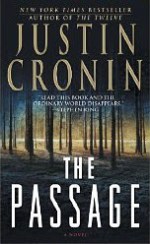
Cover of The PassageI recently finished reading Justin Cronin’s The PassageThis book has garnered quite a bit of attention, and now I can definitely see why. The plot is vampire based, but has the feeling of The Walking Dead, The Strain (also see my previous post), and Cormac McCarthy’s The Road. Coming in at over 800 pages and covering over a hundred years, this is truly epic vampire fiction. The story starts in modern day United States where scientists are, of course, screwing around and trying to militarize several hardened criminals and one 8-year-old girl. When that doesn’t end particularly well, the story moves ahead to the future where we follow the struggles of Peter Jaxon, a young man who has grown up in a post-apocalyptic world and who finds himself on track to possibly save what’s left of the human race. There is action and adventure, romance, horror, and throughout it all excellent character development.

While Cronin takes his time with the storytelling, he does so with purpose. He builds from the character of Amy, a young girl who has pretty much grown up rough, living in motel rooms with her mother. We are then introduced to Wolgast, the FBI agent who has been procuring test subjects for his supervisor and whose loyalty to his job is seriously tested when one of those subjects turns out to be Amy. After we become invested in these characters and what will happen next to them, Cronin takes us far into the future and introduces us to a new cast of characters, those of one of the last human settlements in existence. The success of getting a reader to reinvest in a whole new set of characters midway through the story is one that has to be applauded. The setting and everything changes, but it works and I was again drawn in by Peter Jaxon and his brother Theo, who work the night watch on the wall surrounding the colony; Michael Fisher, a technical whiz who keeps the lights on, and his sister Sarah, a nurse; Hollis Wilson, the classic good guy; Mausami Patel, who also works the night watch on the wall; Caleb Jones, the younger guy in love with old style high top shoes; and, especially, Alicia Donadio, the lone wolf badass.

Cronin knows just how to hit where it hurts with these characters. At several points happiness seems almost within grasp only to be whisked away, or someone commits an act of bravery only to pay the ultimate price. Figuring out who will live through the various adventures is part of the fun, and it’s one of those books where you hate see someone go down. And, at the center of it all is the mystery of Amy, who and what she is, and what part she will end up playing.

Oh, and there are vampires. Creepy, long-living vampires, who have some major psychological skills when it comes to telepathy torture. Fast, lithe vampires, that are smart enough to figure out traps and make plans. Crafty vampires that travel in pods of three and will case out your position for days in advance before attacking with a vengeance. Strong and hard to kill vampires that require expert marksmanship and amazing luck to outlive. Masses and hordes of vampires almost everywhere — hanging under bridges, hiding in abandoned buildings, creeping through the woods at night. Heartbreaking vampires that always, always return — one last time — to where they lived before they were turned.

Finishing this book definitely made me ready to start the sequel, The Twelve. If you are looking for a lovely, scary book to dig into this Halloween season, this should definitely be on your list!

The Grimscribe’s Puppets: Stories Inspired by Thomas Ligotti

Cover of The Grimscribe's PuppetsIf you’ve read some of my previous posts, you may know that I am a big fan of Thomas Ligotti. So, I was super excited to hear about The Grimscribe’s Puppets, a collection of Ligotti themed stories edited by Joe S. Pulver. I was definitely not disappointed by this book and highly recommend it!

As indicated by the title, the theme of this collection has to do with puppetry — manipulations both real and existential — and this theme is approached from a variety of perspectives. The stories here are often from the point of view of the puppet or the puppet-master, but many times this aspect is explored at the larger, more terrifying level, such as who is out there and how are they controlling me? The collection has a well-selected mix of this overall idea presented in ways that are a tribute to both Ligotti’s themes and his atmospheric settings.

My favorite in what I might call the “puppet viewpoint” category was Cody Goodfellow’s “The Man Who Escaped This Story,” in which a man discusses various dreams, or fugue states, with his psychiatrist where he seems to be just a player in a drama put on by some force greater than himself. This idea of being captive to the whims of an unknowable godlike creature and used for their amusement over and over again is unsettling and will stick with me. In “Furnace” by Livia Llewellyn, a young girl watches her town slowly eaten away by forces that she cannot understand, and it is only slowly that she comes to the realization of the role that she plays in a slow destruction of the world. Daniel Mills explores religious fervor with a twist in “The Lord Came at Twilight,” when a dangerous “revival” consisting of dark beliefs sweeps through a town. In “Diamond Dust” by Michael Griffin, a man slowly makes connections between strange occurrences and the odd art his girlfriend has been creating. And, Paul G. Tremblay’s “Where We All Will Be” explores the viewpoint of a single, clear-headed observer during a mass infiltration of human minds.

A few authors look at the topic from the viewpoint of the puppet-master, and the most clear-cut of these would be Jon Padgett’s “20 Simple Steps to Ventriloquism,” which provides some basic, and more advanced, how-to in puppet mastery. However, sometimes the role of puppet and puppet-master can dovetail, something that the puppet maker in Simon Strantzas “By Invisible Hands” comes to realize first-hand. And, Jeffrey Thomas’s “The Prosthesis” explores a situation in which the puppet created may have been a job done just a little too well.

I really enjoy some of the more grotesque elements of Ligotti, where we see characters that are either not quite human or so corrupted as to be verging on less than human. Two of the stories in this collection do this exceptionally well. Both involve female characters who struggle to survive, and who each somehow become both prey and predator. Kaaron Warren’s moth girl in “The Human Moth” has a hard time satisfying her basic needs, while Allyson Bird’s protagonist in “Gailestis” attempts to work out some more traditional methods for survival, but things don’t quite turn out as expected.

There are also some stories in which we see the familiar post-industrial landscapes from Ligotti’s work. Darrell Schweitzer’s protagonist in “No Signal” struggles to reach those he loves even as he watches his world change and fade. A young girl in Nicole Cushing’s “The Company Town” is uprooted by her father and moved to a strange new town where it seems that her future existence will be paid for on the installment plan. And, in “The Holiness of Desolation” Robert M. Price gives us the viewpoint of a man making his way through a strange, dystopian world where the end of humanity may be contained within the written word.

Possibly one of Ligotti’s most powerful areas of writing is that which combines a character’s alienation with loss of self, or someone close, in some existential or physical manner. My absolute favorite of these stories was the haunting contribution by Eddie M. Angerhuber,”The Blue Star,” in which a man takes us through his annual visit to a strange city where he lost his love to an alien force years ago. I also really enjoyed Gemma Files contribution, “Oubliette,” which used a variety of formats — diary entries, IMs,  emails, etc. — to tell the story of a suicide survivor haunted by cult member ghosts with a mission. John Langan’s “Into the Darkness, Fearlessly” puts a new twist on the idea of getting lost in a text, and Richard Gavin’s “After the Final” explores the inner workings of a fanatical and delusioned mind.

Some of these stories have some very dark, existential implications, such as “The Secrets of the Universe” by Michael Cisco, which relates a discussion on life, the universe, and everything between master and victim. “The Xenambulist: A Fable in Four Acts” by Robin Spriggs examines an increasingly strange and out of control world, one that the protagonist will not escape from. And, in “Eyes Exchange Bank,” by Scott Nicolay, a man on the verge of a breakdown over loss of love and a stagnant dissertation comes to the realization that there are darker things out there to fear. There are many dark things to fear in this book, many shadows. Michael Kelly’s character in “Pieces of Blackness” is haunted by a shadow from the past that won’t forgive or forget, and in “Basement Angels” Joel Lane’s character finds that his shadow is a much more important part of him than he ever realized.

The Grimscribe’s Puppets won the 2013 Shirley Jackson Award for Edited Anthology for good reason. Joe S. Pulver has selected some excellent authors and put together a significant contribution to the genre, which is packed full of stories that will challenge your assumptions and haunt you for years to come. Be sure not to miss this one!